When several months of accounts are behind, the first decision is often how to catch up without losing control of the business. Backlog accounting in the UAE starts with establishing which records exist, what has already been posted and which balances can be supported. A useful starting point is a clear scope and an evidence checklist, rather than a promise that everything can be fixed in a few days.
When does an accounting backlog need attention?
Common signs include bank accounts that have not been reconciled, financial reports that stop several months ago, a change of accountant, receipts stored across spreadsheets and email, or a year-end review approaching without a reliable trial balance. A quiet trading period does not necessarily mean there is no accounting work: bank charges, owner funding, supplier balances and asset movements may still need recording.
Catch-up bookkeeping reconstructs and checks historic transactions. It is different from an audit, which involves a separate assurance engagement, and from submitting or correcting a tax return. Agree which of these services is actually included before work starts.
Start with the records you already have
Make a list of the periods outstanding and every business bank account, company card, payment gateway and accounting system used. Export the available statements and ledger reports before changing systems or access permissions. Keep original files and a clear copy of what has been handed over. Do not delete old entries or duplicate transactions simply because a balance looks wrong.
- Bank and card statements for every relevant month, including foreign-currency accounts.
- Sales invoices, credit notes, customer statements and payment-gateway settlement reports.
- Purchase invoices, expense receipts, supplier statements and unpaid bills.
- Payroll records, leases, loan agreements and significant business contracts.
- Previous trial balances, financial statements and available reconciliation schedules.
- Tax registration details, filed returns and related working papers where applicable.
If records are incomplete, identify the missing period and document type. A bank statement is useful evidence of a payment, but it does not always explain the business purpose or replace the documentation needed for a tax position. Keep an open-items log instead of treating assumptions as confirmed facts.
Discuss the backlog before sending sensitive files
For an initial enquiry, tell PeterMorrison how many periods are outstanding, which software you use and whether the statements and invoices are available. There is enough to begin a scoping discussion. Request an agreed transfer method before sharing identity documents or confidential financial records. Explore our Backlog Accounting service or discuss your accounting backlog.
What does a catch-up engagement involve?
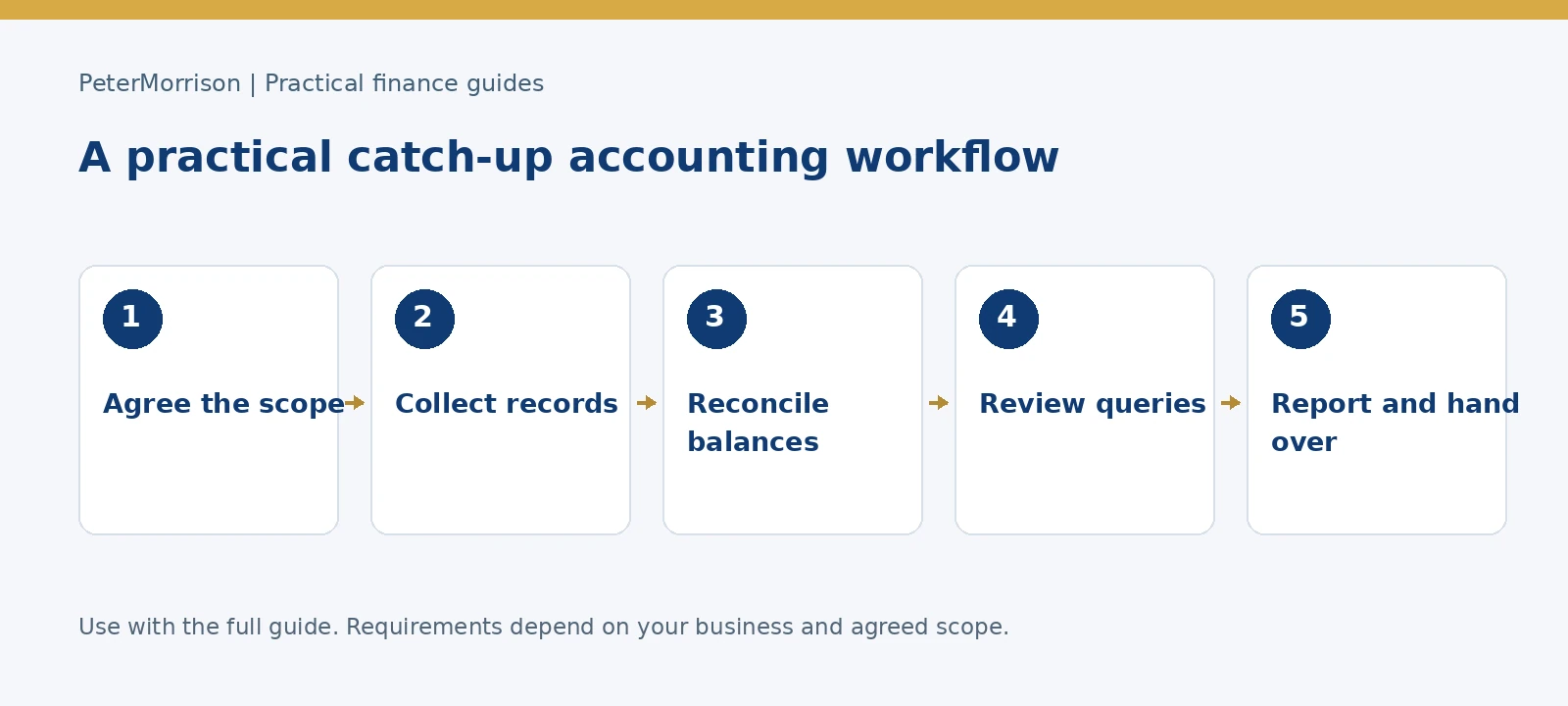
- Scope: agree the entities, periods, deliverables and responsibilities.
- Collect: gather source documents and identify gaps before bulk posting.
- Reconcile: compare ledger entries with banks, customers, suppliers and supporting schedules.
- Review: investigate unexplained differences and record approved adjustments with an audit trail.
- Report: agree final outputs, unresolved issues and the handover into routine monthly accounting.
Ask what you will receive: a reconciled trial balance, management reports, supporting schedules, an adjustments log and a list of remaining queries may all be relevant. The exact outputs depend on the engagement. Clearly distinguish accounts preparation from audit assurance and separate tax compliance work.
What affects the quote and completion time?
The number of months is only one factor. Transaction volume, the number of accounts, currencies, software, missing documents, opening-balance quality and the extent of reconciliation work all affect effort. A business with complete statements and invoices can have a different scope from one with the same number of months but incomplete evidence. Any urgent reporting deadline should be explained at the start; it is not a substitute for a realistic work plan.
Ask whether the quotation includes source-data entry, bank reconciliations, opening-balance checks, accounting adjustments and financial reports. Clarify separately whether payroll review, software ownership, tax submissions and auditor liaison are included. Changes in scope should be agreed rather than discovered at handover.
Keep the backlog from returning
Agree a monthly document cut-off, a person responsible for approvals and a schedule for reconciliations and management review. Keep business and personal transactions distinguishable and investigate missing evidence while it can still be found. Our UAE month-end bookkeeping checklist is a useful starting point, and ongoing accounting support can provide a regular reporting cadence within an agreed scope.
Frequently asked questions
Can work begin without every invoice? A scoping review can identify the gaps, but the treatment of unsupported items must be considered on its facts. Missing documents do not justify invented entries or tax claims.
Is catch-up bookkeeping the same as filing a tax return? No. A tax computation or return may use the resulting accounts, but the review and filing work should be separately identified.
Will historical bookkeeping replace an audit? No. Preparing accounts and supporting schedules does not provide independent audit assurance.
Ready to discuss the periods outstanding?
Tell us your business activity, the periods behind, the software used and the records currently available. PeterMorrison can discuss a scope for bringing the accounts up to date and the ongoing support needed afterwards. Discuss your accounting backlog to reach the existing consultation page.
General information only. Accounting and tax treatment depend on the facts and applicable requirements; confirm the engagement scope and obtain advice relevant to your business before acting.