


UAE e-invoicing readiness is a finance and operational project as well as a software project. Before choosing a solution, identify the transactions your business issues, where the data comes from and who will own exceptions. The useful outcome is a controlled invoice process that your finance team can operate and explain.
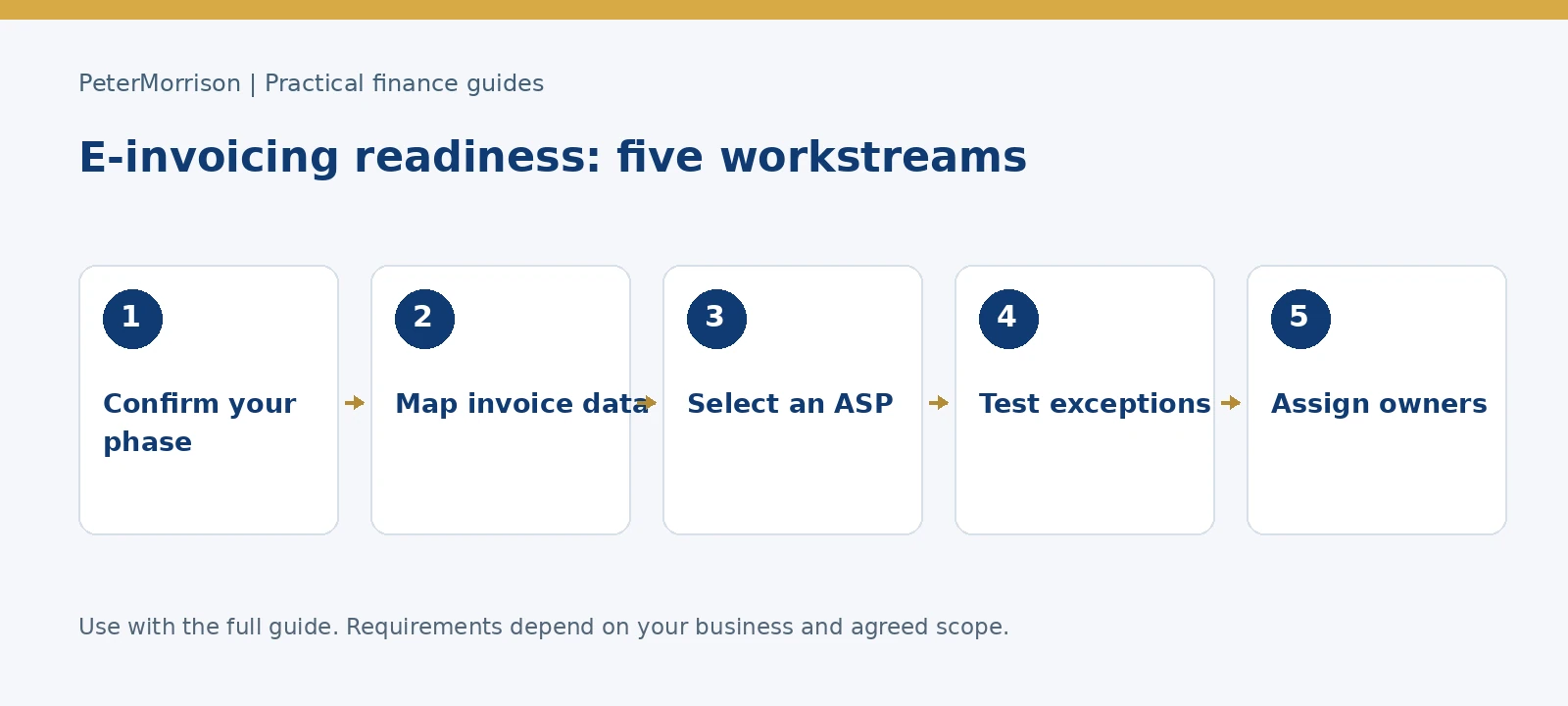
Confirm the current phase before building a timeline
The FTA’s October 2026 announcement identifies 1 January 2027 as the implementation date for in-scope persons with annual revenue of AED 50 million and above. It identifies 30 October 2026 as their ASP appointment deadline, which has already passed. A business in that phase should assess its position promptly rather than treating the appointment milestone as a future date.
The published phased framework distinguishes smaller businesses and government entities. Check the current Ministry of Finance e-invoicing portal for scope, exclusions and the phase applicable to your organisation. Do not assume that every small company must go live in January, or that an old timetable still reflects later amendments.
A PDF invoice is not the readiness test
The Ministry describes an eInvoice as structured invoice data exchanged electronically and reported through the programme. A PDF, scan or emailed invoice alone is not the same thing. Your current application may produce an attractive invoice while still requiring data mapping, provider integration and process changes. Ask your software supplier to demonstrate the actual end-to-end flow rather than simply confirming that it supports “digital invoices”.
Build a finance-owned data checklist
- List the entities, branches and systems that issue invoices and credit notes.
- Map customer and supplier master data, legal names, tax identifiers where relevant, addresses and transaction references.
- Identify the source of invoice dates, currencies, line descriptions, quantities, tax categories and amounts.
- Check how discounts, advances, returns, credit notes and corrections are represented.
- Document who can create or amend master data and who approves an exception.
- Compare sample transactions across the sales system, accounting ledger and available tax records.
Treat this as a gap review, not a claim that every field applies in every situation. Validate the final mapping against the current official mandatory-field specification and your provider’s implementation requirements. Keep a short register showing the field, source system, accountable person, known issue and target resolution date.
Separate the provider’s role from the accountant’s role
An Accredited Service Provider handles functions within the official technical framework. An accountant can help review invoice records, reconciliations, accounting treatment and the financial controls around the process. These responsibilities should be written down separately. PeterMorrison’s VAT transaction advisory and accounting services provide a starting point for discussing finance-record support; this article does not represent PeterMorrison as an accredited technical provider.
The October 2026 accreditation update replaced the previous framework. Check the current accredited-provider information and the exact contracting entity instead of relying on an old preliminary approval or a marketing badge.
Questions to ask before signing a provider proposal
- Which issuing systems, entities and transaction types are included?
- What data cleanup must our business complete before integration?
- How are rejected invoices, duplicate submissions and credit notes handled?
- Who can access the records, and how can we export them?
- What testing evidence and support are included in the quoted scope?
- What are the implementation, recurring and change-request costs?
- Who owns the incident response and reconciliation between invoices and the ledger?
Test real exceptions, not just a successful sample
Choose representative anonymised cases from your business: a standard sale, a credit note, a foreign-currency transaction and an exception relevant to your operations. Record the expected result, actual result and person approving the test. Finance should be able to identify whether an invoice was accepted, corrected or still pending and reconcile the outcome to the books.
Maintain a simple weekly readiness meeting with open issues, owners and decisions. Avoid unsupported claims that changing accounting software automatically delivers compliance. The operating process and the evidence of testing matter alongside the application.
Frequently asked questions
Should we replace our accounting software immediately? First establish the applicable requirements and whether the existing system can work with an appropriate provider. Compare a supported integration with replacement costs and risks.
Can an adviser guarantee our implementation? Ask for the exact deliverables and dependencies. Record review, tax advice and technical implementation are distinct scopes.
Discuss your invoice-record readiness
Tell PeterMorrison your business activity, approximate invoice volume, systems used and the phase you believe applies. Discuss your invoice-record readiness so the finance support can be scoped around your actual records and responsibilities.
Official framework checked on 11 November 2026. Recheck the linked Ministry and FTA materials before acting; later amendments may affect scope, deadlines or implementation requirements. General information, not a business-specific compliance determination.